Low Resistance Testing: The Smallest Measurement That Protects the Biggest Electrical Systems
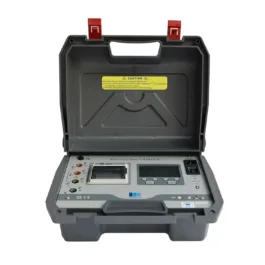
Why Modern Reliability Teams Depend on Motwane Low Resistance Testers
Walk into any plant after an electrical failure and you’ll notice something interesting.
No one talks about insulation first.
No one talks about design mistakes.
The first question is almost always:
“Which connection heated up?”
Because experienced engineers know something many others overlook:
Most electrical failures don’t start with dramatic breakdowns.
They start with a tiny rise in resistance at a connection point.
A joint loosens.
A lug oxidizes.
A contact pits slightly.
The resistance climbs just a few milliohms.
Not enough to trigger alarms.
But enough to generate heat.
And heat quietly eats away at reliability.
Hours later — or days — you’re facing:
- burnt contacts
- damaged breakers
- melted busbars
- unplanned shutdowns
- expensive downtime
What caused all this?
A resistance change smaller than what a basic meter could even detect.
This is why low resistance (LR) testing has become a cornerstone of preventive maintenance worldwide.
It’s not glamorous.
It’s not high-voltage drama.
But it’s one of the most powerful ways to prevent electrical disasters.
And when engineers need precise micro-ohm measurements they can trust, they turn to Motwane low resistance testers — instruments designed specifically for real industrial conditions.
Introduction: Why Low Resistance Deserves More Attention Than It Gets
Let’s be honest.
Low resistance testing rarely gets the spotlight.
People talk about:
- insulation resistance
- breakdown voltage
- hipot tests
- high voltage diagnostics
But few people celebrate the test that quietly prevents most problems.
Yet, statistically, connection failures account for a large percentage of electrical breakdowns.
Every electrical path has joints:
- bolted busbars
- cable terminations
- breaker contacts
- earthing straps
- transformer windings
Each one must behave like a perfect conductor.
If resistance increases, three things happen:
- Heat rises
- Energy loss increases
- Material degrades faster
And once degradation starts, failure accelerates.
It’s a snowball effect.
The goal of LR testing
Simple:
Find weak connections before they fail.
That’s it.
But achieving that requires precision — and the right equipment.
Technical Overview: The Science Behind Low Resistance Testing
Measuring low resistance isn’t just “checking ohms.”
At micro-ohm levels, physics becomes tricky.
Even test leads and clamps add resistance.
Which means poor methods = wrong conclusions.
The Kelvin Principle (4-Wire Method)
Professional low resistance testers use a four-wire technique.
Here’s why:
If you use two wires:
- lead resistance mixes with measurement
- results become inaccurate
So instead:
- two wires carry current
- two wires measure voltage
This separates measurement from lead resistance.
Result → extremely accurate values
This technique is standard in high-quality Motwane low resistance testers.
Why High Current Injection Matters
Low resistance means tiny voltage drop.
Tiny drop = harder to measure.
So testers inject high current:
- 10A
- 50A
- 100A
- sometimes 200A
Higher current creates a measurable voltage difference.
This improves:
- accuracy
- repeatability
- confidence
And confidence is critical when maintenance decisions affect production.
Industry Standards That Guide Testing
Testing practices often follow:
- IEC standards
- IEEE guidelines
- IS standards
- OEM manuals
These standards recommend regular contact and winding resistance checks because history has shown:
Ignoring connections leads to failure.
Equipment Overview: Motwane Low Resistance Testers in Action
Now let’s talk about the tool itself.
Because low resistance testing is only as good as the tester you use.
Instruments that drift, fluctuate, or overheat create unreliable data.
And unreliable data is worse than no data.
What Engineers Expect from a Professional Tester
They need:
- stable current output
- accurate micro-ohm resolution
- fast readings
- rugged body
- easy field handling
- data storage
- safety features
How Motwane Delivers
Motwane designs low resistance testers specifically for:
- substations
- plants
- heavy industrial environments
- outdoor work
Key advantages:
✔ True Kelvin measurement
✔ High current injection
✔ Durable construction
✔ Quick test cycles
✔ Portable design
✔ Digital logging
✔ Consistent repeatability
✔ Made for Indian field conditions
Engineers like Motwane because it feels practical.
No unnecessary complexity.
Just reliable performance.
And reliability is exactly what LR testing is about.
Practical Applications: Where Low Resistance Testing Makes the Biggest Difference
Low resistance issues appear anywhere heavy current flows.
Which means almost everywhere.
Switchgear
Detect hot joints before they burn panels
Transformers
Identify winding imbalance early
Circuit Breakers
Measure contact wear
Cable Systems
Validate terminations
Earthing Networks
Confirm safe grounding
Railways
Ensure return current integrity
Process Industries
Avoid shutdowns in continuous production
In short:
If failure is expensive, LR testing is mandatory.
Step-by-Step Guide: Field-Friendly Testing Method
Here’s how most experienced technicians perform low resistance testing.
Step 1 — Isolate Equipment
Never test live circuits
Step 2 — Visual Inspection
Look for discoloration, rust, loose bolts
Step 3 — Clean Surfaces
Remove oxide and contamination
Step 4 — Connect Kelvin Leads
Current + sense separately
Step 5 — Select Current Range
Match conductor size
Step 6 — Measure
Wait for stable value
Step 7 — Compare
Check against similar joints
Step 8 — Record
Create trend history
Safety Tip
High current injection can cause heating.
Never touch test points during measurement.
Troubleshooting & Interpretation: What Your Readings Really Mean
Think of LR values as symptoms.
They reveal hidden problems.
Normal reading
Healthy joint
Slight increase
Possible loosening or dirt
Large increase
Immediate maintenance needed
Fluctuating values
Poor contact or probe issue
Phase mismatch
Winding defect suspected
Smart Practice
Compare similar components.
One abnormal value stands out immediately.
That’s how most faults are discovered.
Real-World Examples from the Field
Example 1 — Production Line Saved
LR testing revealed high resistance in one busbar joint.
Tightened → temperature dropped → avoided shutdown.
Example 2 — Transformer Health Check
Unequal winding resistance flagged internal problem.
Repair scheduled before failure.
Example 3 — Breaker Reliability Improved
Contact resistance trending upward.
Contacts replaced proactively.
No trip. No emergency. No downtime.
That’s the power of preventive testing.
Benefits & ROI: Why Management Should Support LR Testing
Low resistance testing isn’t just technical — it’s strategic.
It reduces:
- emergency repairs
- downtime losses
- fire risks
- maintenance chaos
And improves:
- asset life
- reliability
- safety
- compliance
Even one prevented breakdown pays for the tester many times over.
Which makes a Motwane low resistance tester not an expense, but an investment.
A Different Way to Think About It
Imagine driving a car with slightly loose wheel nuts.
It drives fine.
Until it doesn’t.
Low resistance issues are similar.
Everything works… until it suddenly fails.
Testing simply tightens the “wheel nuts” of your electrical system.
Small action. Massive safety.
Future Trends: Smarter Testing Ahead
Low resistance testing is evolving.
Soon we’ll see:
- automated test scheduling
- cloud-based reports
- wireless data transfer
- predictive maintenance dashboards
- AI-driven health analysis
Motwane is actively moving toward smarter, connected solutions.
Because the future isn’t reactive maintenance.
It’s predictive reliability.
Conclusion: Precision at the Milliohm Level, Protection at the Megawatt Level
It’s easy to focus on big numbers in electrical engineering:
kilovolts
megawatts
megavars
But sometimes, the smallest numbers matter most.
Milliohms.
That’s where failures begin.
And that’s where smart teams pay attention.
Low resistance testing isn’t complicated.
It’s disciplined.
It’s consistent.
It’s preventive.
With dependable tools like Motwane low resistance testers, engineers gain certainty — and certainty keeps plants running.
Because in modern industry, uptime is everything.
And uptime starts with strong, low-resistance connections.


Comments
Post a Comment