10KPI Test Set
10KPI Test Set:When Insulation Testing Must Go Beyond Routine and Reach Absolute Certainty
In high voltage systems, insulation is not simply a protective layer. It is the foundation of reliability. When insulation weakens, failure does not ask for permission. It simply occurs.
Most facilities perform insulation resistance tests at moderate voltages. That works well for standard motors and medium voltage equipment. But once systems operate at higher voltage classes, ordinary testing is not enough. The stress levels inside those assets demand a more powerful diagnostic approach.
This is where the 10KPI Test Set becomes essential.
10KPI refers to 10 kilovolt Polarization Index testing. It is a high voltage insulation diagnostic method used to evaluate the integrity of insulation systems in heavy electrical equipment. It does not merely check resistance. It evaluates insulation behavior under sustained high electric stress.
For engineers responsible for turbines, large motors, high voltage cables, and transmission assets, 10KPI testing is not an upgrade. It is a necessity.
Introduction
What 10KPI Testing Really Means and Why It Matters
At its core, 10KPI testing measures insulation resistance at 10 kilovolts DC and calculates the Polarization Index ratio over time.
Why 10 kilovolts?
Because large equipment such as generators, transmission cables, and high voltage motors operate under significant electrical stress. Testing them at lower voltages may not reveal deep insulation weaknesses. Higher test voltage exposes hidden moisture, contamination, micro cracks, and ageing effects that remain invisible at 1 kV or 5 kV.
The Polarization Index adds time based evaluation. Instead of a single reading, the test compares resistance at one minute and ten minutes.
Healthy insulation responds by increasing resistance over time.
Deteriorated insulation shows flat or unstable behavior.
This difference is not cosmetic. It determines whether your asset continues operating safely or moves closer to breakdown.
When insulation fails in high voltage equipment, consequences include:
• Flashover
• Arc faults
• Winding damage
• Prolonged outage
• Expensive rewinding or replacement
10KPI testing helps prevent those outcomes by identifying weakness early.
Technical Overview
How 10KPI Testing Works
Understanding the physics behind the test helps in interpreting results accurately.
1. Application of 10 kV DC Voltage
The 10KPI Test Set applies a stable 10,000 volt direct current across the insulation system. This creates a strong electric field that penetrates insulation layers deeply.
2. Current Components
When voltage is applied, three types of current flow:
1 Capacitive charging current
2 Dielectric absorption current
3 Leakage current
In healthy insulation:
• Charging current drops quickly
• Absorption current decreases gradually
• Leakage current remains low
In contaminated insulation:
• Leakage current stays elevated
• Resistance does not rise significantly over time
3. Polarization Index Calculation
PI = Resistance at 10 minutes divided by Resistance at 1 minute
Typical interpretation guidelines:
• Below 1.0 indicates serious moisture or contamination
• 1.0 to 2.0 indicates questionable condition
• Above 2.0 generally indicates good insulation
• Above 4.0 suggests excellent dryness and integrity
Values vary by equipment class and industry standards.
Standards and Compliance
10KPI testing aligns with established technical standards such as:
• IEEE 43 for rotating machinery
• IEC 60034 for electrical machines
• NETA maintenance testing specifications
These standards provide reference limits and testing recommendations for high voltage assets.
Adhering to standards ensures that results are meaningful and defensible during audits or investigations.
Equipment Overview
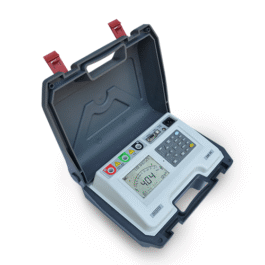
Motwane 10KPI Test Set
Testing at 10 kilovolts requires precision engineering and robust safety design. Motwane designs its 10KPI Test Set to deliver both.
The instrument is engineered for high voltage field environments while maintaining laboratory grade accuracy.
Key Features
• Stable 10 kV DC output
• Automatic Polarization Index calculation
• High insulation resistance measurement in gigaohm range
• Built in timer for one minute and ten minute readings
• Guard terminal to eliminate surface leakage
• Digital display with clear readability
• Internal memory for test record storage
• Automatic discharge after testing
• Rugged enclosure for site use
Why Engineers Trust Motwane
Precision matters at 10 kV. Even small instability in output voltage can distort readings. Motwane instruments provide steady voltage delivery and reliable measurement circuitry.
Field technicians appreciate:
• Simple user interface
• Quick setup
• Reliable discharge safety
• Consistent readings for trend comparison
For maintenance managers, the biggest advantage is data consistency. Reliable trending supports long term asset health planning.
Practical Applications
Where 10KPI Testing Is Critical
10KPI testing is essential in high voltage installations such as:
Power Generation Plants
• Turbo generators
• Stator windings
• High voltage excitation systems
Transmission and Distribution Networks
• High voltage cables
• Substation equipment
• Bushings
Heavy Industrial Facilities
• Large synchronous motors
• Mining drives
• Cement plant kilns
Renewable Energy Installations
• Wind turbine generators
• Grid connected step up transformers
In all these environments, insulation failure can shut down entire operations.
10KPI testing provides early detection before that happens.
Step by Step Guide
How to Perform 10KPI Testing Safely and Correctly
High voltage testing demands discipline.
Step 1 Isolate Equipment
Ensure complete electrical isolation. Follow lockout procedures. Verify absence of voltage.
Step 2 Inspect Visually
Look for visible cracks, contamination, oil leakage, or mechanical damage.
Step 3 Connect Leads
• Positive lead to conductor
• Negative lead to ground
• Guard terminal if required
Ensure secure connections.
Step 4 Select 10 kV Output
Confirm equipment voltage rating before applying full 10 kV.
Step 5 Start Test
• Record one minute resistance
• Continue to ten minutes
• Allow instrument to compute PI automatically
Step 6 Discharge Completely
After test completion, allow automatic discharge cycle to finish before disconnecting.
Safety Tips
• Never test energized equipment
• Maintain proper clearance
• Wear insulated gloves
• Confirm test voltage suitability
• Keep personnel at safe distance
At 10 kV, respect for safety is not optional.
Troubleshooting and Interpretation
Reading numbers is only the beginning.
Low Resistance and Low PI
Likely heavy moisture contamination or insulation degradation.
Action: Investigate drying or refurbishment.
High Resistance but Low PI
Possible surface leakage or contamination.
Action: Clean surfaces and retest.
Declining PI Trend Over Years
Indicates gradual ageing.
Action: Schedule maintenance before failure.
Sudden Sharp Drop
Possible internal fault or insulation puncture.
Action: Conduct further diagnostics such as tan delta or partial discharge testing.
Trend data is powerful. A single test provides a snapshot. Multiple tests provide a story.
Case Studies
Real World Lessons from 10KPI Testing
Case Study 1 Power Plant Generator
Annual 10KPI testing showed gradual PI reduction over three cycles. Maintenance team scheduled controlled drying during planned outage.
Generator returned to service with restored insulation values. No forced outage occurred.
Case Study 2 Mining Motor Failure
A mining company skipped high voltage PI testing on a 13.8 kV motor. Insulation breakdown occurred unexpectedly, halting production.
Post failure analysis showed low PI values months before breakdown.
Case Study 3 Utility Preventive Strategy
A utility adopted periodic 10KPI testing using Motwane equipment. High voltage cable insulation weakness was detected early. Cable replaced before in service failure.
Operational reliability improved measurably.
Benefits and Return on Investment
From a financial and operational perspective, 10KPI testing delivers clear advantages.
1 Enhanced Safety
Early detection reduces arc fault risk.
2 Reduced Downtime
Failures are addressed during scheduled outages rather than emergencies.
3 Extended Asset Life
Dry and healthy insulation lasts longer.
4 Improved Maintenance Planning
Data driven decisions replace reactive repairs.
5 Financial Protection
The cost of one generator rewind can exceed the investment in professional test equipment many times over.
Testing is predictable. Failures are not.
Future Trends
Where High Voltage Insulation Testing Is Heading
Electrical diagnostics is moving toward intelligent asset management.
Emerging developments include:
• Digital data logging
• Bluetooth result transfer
• Integration with maintenance software
• Automated trend visualization
• Predictive algorithms
The future of 10KPI testing is not only measurement but interpretation.
Smart systems will combine insulation data with temperature, vibration, and load patterns to forecast failure risk.
Motwane continues to align its high voltage testing solutions with these evolving maintenance strategies.
Conclusion
Why 10KPI Testing Is Non Negotiable
High voltage insulation does not fail overnight. It weakens gradually under thermal, electrical, and environmental stress.
10KPI testing reveals that weakness before it becomes catastrophic.
For engineers, it provides measurable confidence.
For technicians, structured diagnostic clarity.
For decision makers, protection of high value infrastructure.
With reliable 10KPI Test Sets from Motwane, organizations gain precise insight into insulation health and the ability to act before failure strikes.
In modern electrical systems, reliability must be verified at the highest stress level the equipment will face.
And that verification begins with 10KPI testing.


Comments
Post a Comment