INSULATION RESISTANCE 10KPI
The High-Voltage Truth Test for Critical Electrical Assets
That is why experienced engineers don’t rely on basic checks alone.
When equipment operates at high voltage, carries strategic load, or supports critical infrastructure, insulation resistance testing must go deeper. This is where Insulation Resistor 10KPI testing becomes essential — not as an optional upgrade, but as a reliability requirement.
For decades, Motwane has designed insulation testing equipment for engineers who understand this reality. Engineers who know that when insulation fails, consequences are rarely minor.
This article explores 10KPI testing from a practical, real-world engineering perspective — what it reveals, why it matters, and how Motwane’s 10KPI instruments support confident, data-driven decisions in high-voltage environments.
Introduction: Why 10KPI Exists When 5KPI Is No Longer Enough
Most electrical teams are familiar with 5KPI insulation resistance testing. It is widely used, effective, and appropriate for a large percentage of industrial equipment.
But there is a clear boundary where 5KPI stops being sufficient.
That boundary appears when:
- Operating voltages increase
- Equipment value becomes critical
- Failure consequences escalate
- Aging infrastructure is pushed harder than designed
At this level, insulation must be evaluated under higher electrical stress, closer to real operating conditions. This is precisely the purpose of 10KPI testing.
10KPI does not replace 5KPI — it extends diagnostic visibility.
It answers a tougher question:
How does this insulation behave when stressed, not just when measured?
For large motors, generators, transformers, and EHV systems, that difference defines whether maintenance is proactive — or reactive.
Technical Overview: How Insulation Resistor 10KPI Testing Works
The Physics Behind 10KPI Testing
When a 10 kV DC voltage is applied to insulation, three current components appear:
- Capacitive Charging Current
Appears instantly and decays rapidly. - Dielectric Absorption Current
Caused by molecular polarization inside insulation materials. - Leakage Current
Indicates contamination, moisture, cracks, or insulation aging.
A healthy insulation system shows:
- Rapid decay of charging current
- Gradual reduction of absorption current
- Extremely low, stable leakage current
A weak system does not.
10KPI testing captures this behavior over time, which is why it is far more revealing than a single resistance value.
What Does KPI (Polarization Index) Really Measure?
Polarization Index is the ratio of insulation resistance measured at:
- 10 minutes
- Divided by resistance at 1 minute
At 10KPI, this ratio is measured under significantly higher electrical stress than 5KPI, exposing weaknesses that remain invisible at lower voltages.
Engineers value KPI because it reflects insulation quality, not just insulation quantity.
Applicable Standards and Industry Practices
10KPI testing aligns with globally accepted engineering practices outlined in:
- IEEE insulation testing recommendations
- IEC guidelines for high-voltage equipment
- OEM maintenance protocols for generators and transformers
While acceptance criteria vary, one principle is universal:
Trending over time is more important than absolute values.
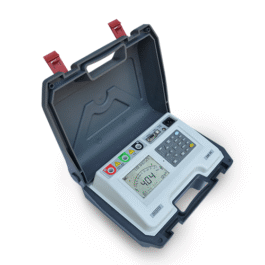
Equipment Overview: Motwane Insulation Resistor 10KPI Instruments
High-voltage insulation testing is unforgiving.
Any instability, noise, or operator error directly impacts data quality and safety.
Motwane designs its 10KPI insulation resistor instruments specifically for this environment.
What Sets Motwane 10KPI Testers Apart
- Stable 10 kV DC Output
Ensures consistent stress application throughout the test duration. - Automatic KPI Measurement
Eliminates timing errors and manual calculation mistakes. - High Measurement Accuracy
Reliable readings even at extremely high resistance values. - Advanced Safety Features
Automatic discharge, overload protection, and operator safety interlocks. - Field-Ready Construction
Designed for substations, plants, and harsh industrial conditions.
Motwane’s philosophy is simple:
A test instrument should reduce uncertainty, not introduce it.
Practical Applications: Where 10KPI Testing Becomes Non-Negotiable
10KPI testing is not used everywhere — and that is exactly why it is powerful.
It is reserved for high-risk, high-value systems where failure is unacceptable.
1. Large Generators
Generators experience extreme electrical and thermal stress.
10KPI testing helps identify:
- Insulation aging
- Moisture absorption during shutdowns
- Weaknesses in stator windings
A single failure can result in months of downtime and massive financial loss.
2. Power Transformers
Transformers represent long-term capital investments.
10KPI testing provides insight into:
- Insulation paper condition
- Moisture ingress
- Long-term aging behavior
It supports condition-based maintenance rather than time-based assumptions.
3. Extra-High Voltage Cables
EHV cable failures are difficult to locate and expensive to repair.
10KPI testing reveals:
- Surface leakage paths
- Installation defects
- Moisture-related degradation
Early detection saves both time and infrastructure.
4. High-Voltage Motors
Critical motors driving compressors, mills, and pumps depend on insulation integrity.
10KPI testing ensures insulation health before commissioning and after overhauls.
5. Utilities and Grid Infrastructure
For utilities, insulation failure is not just an equipment issue — it is a reliability issue.
10KPI testing supports:
- Grid stability
- Preventive maintenance strategies
- Asset life extension programs
Why Engineers Use 10KPI Alongside 5KPI
This is where confusion often arises.
5KPI is excellent for:
- Medium-voltage equipment
- Routine maintenance
- Early-stage diagnostics
10KPI is essential when:
- Operating voltages are high
- Equipment is critical
- Insulation aging is suspected
- Long-term reliability is the priority
Smart maintenance teams use both, not one instead of the other.
Business Perspective: The Real ROI of 10KPI Testing
From a management standpoint, 10KPI testing delivers tangible value:
- Reduced unplanned outages
- Extended equipment life
- Predictable maintenance budgets
- Improved safety compliance
- Higher asset utilization
One avoided transformer or generator failure often justifies the entire insulation testing program.
That is why organizations investing in Motwane 10KPI insulation resistor instruments view them as risk-management tools — not expenses.
The Future: 10KPI in Predictive Maintenance Programs
As electrical maintenance moves toward data-driven strategies, 10KPI testing plays a growing role in:
- Predictive maintenance systems
- Digital asset health platforms
- Long-term insulation trending
High-quality insulation data becomes the foundation for confident operational decisions.
Motwane continues to evolve its testing solutions to support this future — without compromising field reliability.
Conclusion: 10KPI Testing Is About Confidence, Not Compliance
In high-voltage electrical systems, insulation failure is never minor.
It is expensive.
It is disruptive.
It is dangerous.
Insulation Resistor 10KPI testing exists because some equipment demands deeper insight than standard tests can provide.
With Motwane 10KPI instruments, engineers gain clarity — not assumptions.
They energize systems with confidence, not hope.
And in modern electrical networks, that confidence is what separates reliable operation from costly failure.


Comments
Post a Comment