In high-voltage systems, failure rarely announces itself loudly. There is no warning siren when insulation begins to age, absorb moisture, or develop microscopic cracks. The system continues to run — until one day it doesn’t.
By the time insulation failure becomes visible, the damage is usually irreversible.
This is why Insulation Resistance 10KPI testing exists. Not as a routine checkbox, but as a diagnostic lens — one that allows engineers to look deep inside insulation systems operating at the highest stress levels.
For utilities, heavy industry, OEMs, and infrastructure operators, a 10KPI Insulation Tester is not about compliance alone. It is about confidence — confidence that equipment will survive electrical stress today, tomorrow, and years from now.
At Motwane, 10KPI testing is treated as a critical reliability practice that protects high-value assets and prevents failures long before they become disasters.
What Is 10KPI Insulation Resistance Testing — and Why It Matters
10KPI testing refers to insulation resistance measurement at test voltages up to 10 kV, specifically designed for high-voltage equipment such as power transformers, HV motors, generators, long cables, GIS systems, and transmission assets.
Unlike low-voltage IR testing, 10KPI testing replicates real electrical stress conditions, revealing weaknesses that lower test voltages simply cannot expose.
Why standard IR testing is not enough
Lower voltage tests may show “acceptable” values, but:
HV insulation behaves differently under high electric stress
Moisture, contamination, and aging manifest only at higher voltages
Partial degradation can remain hidden until failure
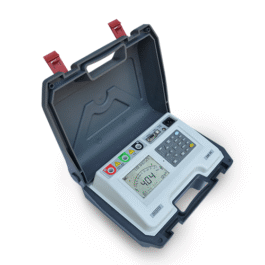
A 10KPI Insulation Tester pushes insulation close to its operational stress level — safely — so engineers can judge its true health.
In short: If the asset operates at high voltage, it deserves high-voltage testing.
Technical Overview: How 10KPI Testing Works
The principle behind insulation resistance testing
Insulation resistance testing measures how effectively insulation resists leakage current when a DC voltage is applied.
In 10KPI testing:
A controlled DC voltage (up to 10 kV) is applied
Leakage current through insulation is measured
Resistance is calculated using Ohm’s law
Why higher voltage reveals more
Think of insulation like a dam:
Low voltage = calm water
High voltage = flood conditions
Cracks that hold during calm conditions may leak during a flood. Similarly, insulation that looks fine at 1 kV may fail under 10 kV stress.
Key parameters measured
Insulation Resistance (IR)
Polarization Index (PI)
Dielectric absorption behavior
Leakage current stability
Relevant standards
10KPI testing aligns with international standards such as:
IEEE 43
IEC 60034
IEC 60502
IS standards for HV equipment
Motwane’s 10KPI instruments are designed to meet these standards while remaining practical for field use.
Reliable in dusty, humid, and high-temperature environments
Supported by strong after-sales and calibration services
When engineers choose Motwane, they choose measurement confidence, not guesswork.
Practical Applications: Where 10KPI Testing Is Critical
10KPI testing is essential wherever insulation failure would mean major downtime, safety risk, or financial loss.
Key industries
Power generation (thermal, hydro, renewable)
Transmission & distribution utilities
Oil & gas and petrochemicals
Steel, cement, and heavy manufacturing
Railways and metros
Large infrastructure projects
Typical assets tested
Power transformers
HV motors and generators
Long HV cables
Bushings and insulators
GIS and switchgear insulation
In all these cases, lower voltage testing is simply not enough to evaluate insulation realistically.
Step-by-Step Guide: How 10KPI Testing Is Performed
Step 1: Preparation
De-energize and isolate equipment
Discharge stored capacitance
Clean terminals and surfaces
Confirm grounding arrangements
Step 2: Instrument setup
Connect test leads securely
Ensure proper earthing
Select appropriate test voltage (up to 10 kV)
Step 3: Apply test voltage
Gradually apply voltage
Observe leakage current behavior
Maintain test for required duration
Step 4: Measure and record
Record IR values
Measure PI where applicable
Note stabilization trends
Step 5: Safe discharge
Allow controlled discharge of equipment
Confirm zero residual voltage
Safety tips
Always follow lock-out/tag-out procedures
Use PPE rated for HV environments
Never rush discharge steps
Motwane’s 10KPI Insulation Testers are designed with operator safety as a priority.
Troubleshooting & Interpretation: Reading Beyond the Numbers
What do good results look like?
High and stable resistance values
Smooth increase in resistance over time
Consistent PI values
Warning signs engineers should never ignore
Rapid drop in resistance
Unstable or fluctuating readings
Low PI values
Significant deviation from historical data
Common causes of poor results
Moisture ingress
Contamination or dirt
Thermal aging
Mechanical damage
Manufacturing defects
Actionable next steps
Drying or reconditioning insulation
Cleaning and sealing
Increased monitoring frequency
Planned replacement instead of emergency failure
10KPI testing is most powerful when used as a trend analysis tool, not a one-time test.
Case Studies: Real-World Impact of 10KPI Testing
Case 1: Preventing transformer failure
A utility performed routine 10KPI testing on an aging transformer. IR values appeared acceptable, but PI was declining year over year.
Action taken:
Oil filtration and insulation drying
Load adjustment
Avoided forced outage during peak season
Case 2: HV motor reliability improvement
A cement plant used a Motwane 10KPI Insulation Tester during shutdown. One motor showed abnormal leakage at high voltage.
Result:
Motor rewound during planned maintenance
Prevented catastrophic in-service failure
Saved weeks of downtime
These are the silent wins of proper 10KPI testing.
Benefits & ROI: Why 10KPI Testing Pays Off
Technical benefits
Early detection of insulation weakness
Accurate assessment under real stress
Improved maintenance planning
Reduced unexpected failure
Business benefits
Lower downtime costs
Extended asset life
Improved safety compliance
Better return on capital equipment
A single prevented failure can justify years of investment in a Motwane 10KPI Insulation Tester.
Future Trends: The Evolution of Insulation Testing
What’s changing
Digital data logging and cloud storage
Integration with asset health systems
Predictive maintenance analytics
Smarter diagnostics beyond single readings
Motwane continues to innovate, aligning insulation testing with modern reliability and asset-management strategies.
Conclusion: 10KPI Testing Is Not Optional — It’s Essential
High-voltage equipment operates under relentless electrical stress. Insulation is its last line of defense — and once it fails, recovery is costly and slow.
5kV Diagnostic Insulation Tester In medium-voltage electrical systems, insulation failure is rarely dramatic at first. There is no spark, no alarm, no visible warning. Instead, insulation slowly degrades — absorbing moisture, aging under thermal stress, and weakening at microscopic levels. By the time failure becomes obvious, the damage is already done. This is where Insulation Resistance 5KPI testing plays a decisive role. For engineers, maintenance teams, and asset owners, a 5KPI insulation resistance tester is not just another test instrument. It is a diagnostic lens — one that reveals the true condition of insulation systems operating in the critical zone between low voltage and high voltage equipment. At Motwanetnm.com , Motwane has built its reputation around helping engineers see problems early, measure accurately, and act with confidence. This blog explores why 5KPI insulation resistance testing remains a non-negotiable practice in modern electrical maintenance — and h...
10KPI Test Set:When Insulation Testing Must Go Beyond Routine and Reach Absolute Certainty 10K-PI Insulation Diagnostic Tester In high voltage systems, insulation is not simply a protective layer. It is the foundation of reliability. When insulation weakens, failure does not ask for permission. It simply occurs. Most facilities perform insulation resistance tests at moderate voltages. That works well for standard motors and medium voltage equipment. But once systems operate at higher voltage classes, ordinary testing is not enough. The stress levels inside those assets demand a more powerful diagnostic approach. This is where the 10KPI Test Set becomes essential. 10KPI refers to 10 kilovolt Polarization Index testing. It is a high voltage insulation diagnostic method used to evaluate the integrity of insulation systems in heavy electrical equipment. It does not merely check resistance. It evaluates insulation behavior under sustained high electric stress. For engineers responsibl...
Low Resistance Test SetThe Small Measurement That Prevents Big Electrical Failures Motwane LR2065-S is a Digital Micro-Ohmmeter In high current systems, a few micro ohms can make the difference between smooth operation and catastrophic overheating. It sounds surprising. Engineers deal with kilovolts, kiloamperes and megawatts every day. Yet, when it comes to joints, busbars, breaker contacts and winding connections, what matters most is resistance measured in milliohms or even micro ohms. Low resistance may appear insignificant on paper. In reality, it governs heat generation, voltage drop, and ultimately system reliability. That is why a Low Resistance Test Set is not just another instrument in the maintenance toolkit. It is a critical diagnostic device that verifies the integrity of current carrying connections. For engineers, industrial technicians and decision makers, accurate low resistance measurement is about safety, efficiency and asset protection. Introduction What Is a...


Comments
Post a Comment