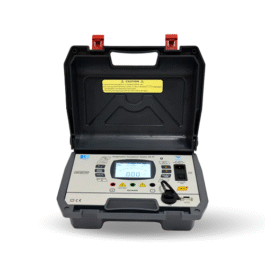
5KPI Test Set
The 5 kV Polarization Index Test That Protects Medium and High Voltage Assets Before Failure Strikes
In industrial power systems, insulation rarely fails without warning. The warning signs are there, but they are electrical, not visual. Moisture, contamination, thermal ageing and mechanical stress gradually weaken insulation until it no longer withstands operating voltage.
When that happens, the result is not a minor inconvenience. It can mean burnt windings, damaged cables, arc faults or plant shutdowns.
The 5KPI Test Set exists to detect those weaknesses early.
By applying 5 kilovolts of direct current and observing insulation behaviour over time, 5KPI testing reveals whether insulation is healthy, ageing or at risk. It moves maintenance from guesswork to measurable evidence.
For engineers, technicians and plant managers, this is not just another test. It is a decision making tool.
Introduction
What 5KPI Means and Why It Deserves Attention
5KPI stands for 5 kilovolt Polarization Index testing. It is a diagnostic method used to evaluate insulation systems in medium and high voltage equipment.
Traditional insulation resistance testing provides a single resistance value. That number is useful, but it only shows a moment in time. Polarization Index testing goes further. It studies how insulation behaves during a ten minute application of DC voltage.
The key measurement is a ratio:
Resistance at ten minutes divided by resistance at one minute.
Healthy insulation continues to increase in resistance during the test. Contaminated or deteriorated insulation does not.
The impact of proper 5KPI testing includes:
• Early detection of moisture ingress
• Identification of insulation ageing
• Prevention of unexpected breakdown
• Better maintenance planning
Testing at 5 kV provides deeper stress than low voltage tests, making it suitable for motors, cables and equipment operating in demanding environments.
When insulation fails in service, it does not give a second chance. 5KPI testing ensures you see the risk before the risk sees you.
Technical Overview
How 5KPI Testing Works
Understanding the physics behind the test helps in interpreting results correctly.
Application of 5 kV DC Voltage
The 5KPI Test Set applies a steady 5,000 volt DC potential between conductor and ground. This creates an electric field across the insulation system.
DC voltage is used because it allows measurement of leakage current behaviour over time without continuous capacitive influence.
Current Components During Testing
When voltage is applied, three currents appear:
- Charging current
- Absorption current
- Leakage current
Charging current decreases quickly.
Absorption current reduces gradually as insulation molecules align.
Leakage current reflects true insulation condition.
Healthy insulation shows decreasing total current and increasing resistance over time.
Weak insulation maintains higher leakage current, resulting in a low Polarization Index.
Interpreting PI Values
While limits vary depending on equipment and standards, general guidelines include:
• PI less than 1 indicates serious contamination or moisture
• PI between 1 and 2 requires investigation
• PI above 2 suggests good insulation condition
• PI above 4 indicates excellent dryness
Standards such as IEEE 43 provide reference values for rotating machinery and other equipment categories.
5KPI testing therefore combines voltage stress and time based behaviour to assess insulation integrity more accurately than a simple resistance check.
Equipment Overview
Motwane 5KPI Test Set
High quality measurement requires stable voltage output and precise current detection. The 5KPI Test Set from Motwane is designed with field reliability and measurement accuracy in mind.
Key Features
• Stable 5 kV DC output
• Automatic Polarization Index calculation
• Wide resistance measurement range
• Built in timer for one minute and ten minute intervals
• Guard terminal to minimize surface leakage errors
• Clear digital display
• Data storage capability for trend analysis
• Automatic discharge after test completion
• Rugged design suitable for industrial environments
Practical Advantages in the Field
Engineers appreciate instruments that are dependable and easy to operate. The Motwane 5KPI Test Set offers:
• Simple user interface
• Reliable voltage stability
• Clear result presentation
• Robust construction for harsh sites
For maintenance managers, consistent results mean better trend tracking and confident planning.
When comparing readings year after year, stability and accuracy make the difference between clarity and confusion.
Practical Applications
Where 5KPI Testing Is Critical
5KPI testing is widely used in environments where insulation integrity directly affects production and safety.
Power Generation
• Auxiliary motors
• Generator stator windings
• Control cables
Industrial Manufacturing
• Medium voltage motors
• Conveyor drives
• Pumps and compressors
Utilities and Infrastructure
• Distribution cables
• Switchgear
• Busbars
Oil and Gas Facilities
• Offshore motors
• Substation equipment
• Control and protection systems
In these industries, downtime is expensive. 5KPI testing provides a structured way to detect insulation weakness before it escalates.
Step by Step Guide
How to Perform a 5KPI Test Safely and Correctly
High voltage testing requires discipline and preparation.
Step 1 Isolate the Equipment
Ensure the equipment is fully de energized. Follow lockout procedures and verify absence of voltage.
Step 2 Inspect Visually
Check for visible contamination, moisture, cracks or loose connections.
Step 3 Connect Test Leads
• Connect positive lead to conductor
• Connect negative lead to ground
• Use guard terminal when necessary to reduce surface leakage influence
Ensure all connections are secure.
Step 4 Select 5 kV Output
Confirm that the equipment is rated for 5 kV testing.
Step 5 Start the Test
• Record resistance at one minute
• Continue measurement until ten minutes
• Allow automatic PI calculation
Step 6 Discharge Safely
Wait for complete discharge before disconnecting leads.
Safety Tips
• Never test live circuits
• Maintain safe clearance
• Use appropriate protective equipment
• Keep unauthorized personnel away
Testing at 5 kV demands respect and caution.
Troubleshooting and Interpretation
Reading the PI value is only the beginning. Understanding what it means is essential.
Low Resistance and Low PI
Likely moisture ingress or severe contamination.
Action: Dry insulation and retest.
High Resistance but Poor PI
Possible surface contamination or uneven insulation ageing.
Action: Clean and evaluate further.
Gradual PI Reduction Over Time
Indicates progressive ageing.
Action: Plan maintenance before failure.
Sudden Sharp Drop in PI
Possible insulation breakdown or internal damage.
Action: Perform additional diagnostics such as tan delta testing.
Trend analysis provides the most reliable insight. One test offers a snapshot. Multiple tests tell the story of insulation health.
Case Studies
Case 1 Medium Voltage Motor in a Cement Plant
Annual 5KPI testing revealed decreasing PI values over three years. Maintenance team scheduled drying during planned shutdown. Motor returned to stable PI levels, preventing costly rewinding.
Case 2 Distribution Cable Monitoring
Utility engineers observed low PI values during routine testing. Investigation revealed moisture ingress at termination points. Repairs were made before in service failure occurred.
Case 3 Manufacturing Facility Breakdown
A facility skipped scheduled PI testing. A motor failure halted production for days. Later testing showed insulation degradation that could have been detected earlier.
These examples illustrate the tangible impact of disciplined 5KPI testing.
Benefits and Return on Investment
Investing in proper insulation testing provides measurable returns.
Enhanced Safety
Reduces risk of arc faults and electrical accidents.
Reduced Downtime
Prevents unexpected equipment failure.
Extended Asset Life
Healthy insulation lasts longer.
Better Maintenance Planning
Enables predictive rather than reactive maintenance.
Financial Protection
The cost of one major motor replacement can exceed the price of testing equipment many times over.
5KPI testing is not an expense. It is a safeguard.
Future Trends
The Evolution of Insulation Diagnostics
Electrical maintenance is moving toward data driven asset management.
Emerging developments include:
• Digital record storage
• Integration with maintenance software
• Remote data transfer
• Predictive maintenance strategies
Modern testing equipment supports long term trend analysis, allowing engineers to detect gradual insulation deterioration with greater confidence.
The future of 5KPI testing lies in combining insulation data with load, temperature and vibration information to create a complete picture of asset health.
Conclusion
Why 5KPI Testing Is Essential for Reliable Electrical Systems
Insulation is the silent barrier that protects every electrical asset. When it weakens, the consequences can be severe.
5KPI testing applies meaningful electrical stress and observes insulation response over time. It reveals hidden risks before they become failures.
For engineers, it provides measurable insight.
For technicians, it offers a clear diagnostic method.
For decision makers, it protects investment and operational continuity.
With precision engineered 5KPI Test Sets from Motwane, organizations gain confidence in their insulation systems and control over their maintenance strategy.
In modern electrical environments, reliability must be proven through testing. 5KPI testing makes that proof possible.


Comments
Post a Comment